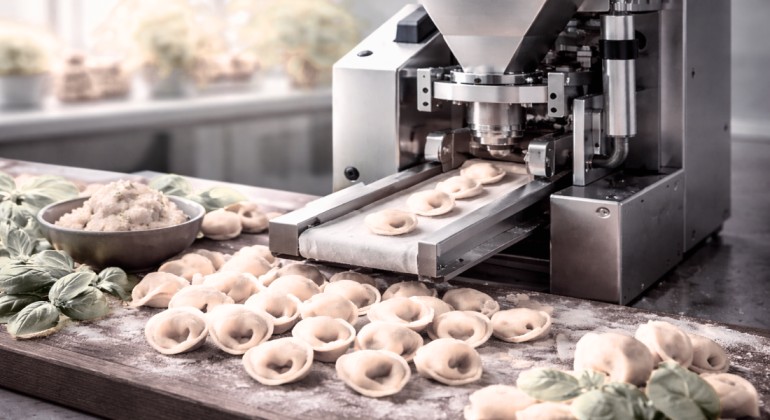
In many Italian homes, tortellini is still made by hand. The dough is rolled thin. A small spoon of filling is placed in the center. Each piece is folded into a tiny ring.
It is a slow and careful process.
Now imagine running a busy restaurant or supplying pasta to supermarkets. You may need thousands of pieces every single day. Making all of them by hand would take too much time and too many workers.
That is why many food businesses use a tortellinatrice. It is a machine that automatically produces tortellini. It helps save time, reduce labor costs, and keep every piece the same size.
What Is a Tortellinatrice?
A tortellinatrice is a commercial pasta machine designed specifically to produce tortellini.
Instead of shaping each piece by hand, the machine does the work in four simple steps:
- Roll the dough into thin sheets
- Adds the filling in equal portions
- Folds and seals the pasta
- Shapes it into small rings
The result looks like handmade tortellini, but it is produced much faster.
Where Tortellini Comes From
Tortellini originate from Italy’s Emilia-Romagna region, particularly in cities such as Bologna and Modena.
For centuries, families prepared it fresh at home. It was part of the celebrations and Sunday meals.
As demand grew across Italy and beyond, production needed to grow too. That is when machines became part of the process.
How the Machine Works
Although it appears complex, the process is easy to understand.
First, the dough is flattened evenly. Thin, even dough helps pasta cook properly.
Next, the filling is measured and placed. This ensures a consistent taste in every bite.
Then the dough folds over and seals tightly to prevent the filling from leaking during cooking.
Finally, the pasta is curved into its classic ring shape.
Some larger systems can produce thousands of pieces in one hour.
Who Uses This Machine?
Different businesses use different sizes.
Large factories use fully automated systems that operate continuously. These connect directly to packaging and freezing lines.
Smaller restaurants and pasta shops often use compact versions. These help them produce fresh tortellini daily without hiring additional staff.
The right choice depends on how much you need to produce each day.
Does Machine-Made Mean Lower Quality?
Not at all.
Quality depends on:
- Good ingredients
- Proper dough preparation
- Correct machine setup
If everything is adjusted correctly, the final product can be just as good as handmade pasta.
In fact, machines can improve consistency. Every piece has the same amount of filling and the same shape. That builds customer trust.
How Much Does It Cost?
Prices vary depending on size and capacity.
- Smaller models may cost between €5,000 and €15,000
- Large industrial systems can cost €30,000 or more
For growing businesses, the investment often makes sense. Lower labor costs and higher output can balance the initial expense over time.
What to Consider Before Buying
Before investing in a tortellinatrice, think about:
- How many pieces do you need daily
- Available kitchen or factory space
- Your future growth plans
- Maintenance needs
- Customer demand
Buying too large can waste money. Buying too small can limit growth. Planning carefully helps avoid both problems.
Common Mistakes to Avoid
- Choosing the cheapest machine without checking the quality
- Ignoring regular cleaning and maintenance
- Not training staff properly
- Underestimating future production needs
Small mistakes can become costly over time.
FAQs
What is a tortellinatrice?
It is a machine that automatically produces tortellini by rolling dough, adding filling, sealing, and shaping it.
Is it only for factories?
No. Smaller models are suitable for restaurants and pasta shops.
How many pieces can it make per hour?
Large systems can produce several thousand pieces per hour.
Can it use different fillings?
Yes, including meat, cheese, and vegetable fillings, as long as the texture is suitable.
How long does it last?
With proper care and maintenance, commercial machines can last 10 to 20 years.
Final Thoughts
The tortellinatrice is not about replacing tradition. It is about keeping up with modern demand.
Handmade tortellini will always have its place in Italian culture. But for restaurants and food manufacturers, machines enable large-scale production.
When used wisely, technology supports tradition rather than replacing it. It simply helps more people enjoy a classic dish faster, while still being made well.