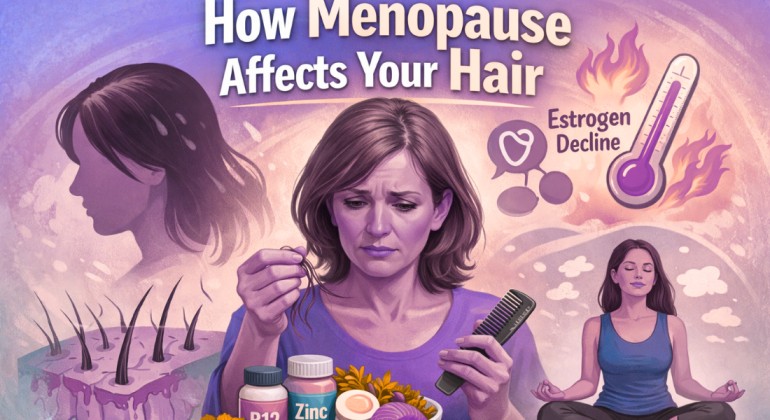
After 40, we often notice changes we didn’t see before: a slightly more visible part, a thinner ponytail, drier ends… and sometimes surprising hair loss. At the same time, our cycles become irregular, we tire more quickly, and hot flashes may occur. The connection is clear: hormones shift, and our hair reacts.
The topic remains discreet despite affecting many women. The good news is that by understanding what’s happening, we can act earlier and more effectively, without panicking or chasing after “miracle products.”
Why does menopause change hair?
It all starts with the gradual decline in estrogen . These hormones don’t just affect the menstrual cycle; they also contribute to the “youthfulness” of the hair. They help prolong the growth phase, protect the follicle, and maintain a more supple hair fiber.
When estrogen levels decrease:
- androgens become proportionally more influential,
- The hair growth cycle can be shortened.
- The hair fiber thins,
- The fall appears more significant.
- Regrowth may be slower and finer.
In some women, hair loss is diffuse, especially along the part or at the crown. It’s important to remember that total baldness is very rare in women. The process is often gradual and can be slowed down.
Common signs after age 45
- A sharper drop than usual
- volume decreases (especially when styling)
- drier, duller, or brittle hair
- lower density in the median zone
- more sensitive scalp
- Regrowth is less “strong” than before
The right steps to limit hair loss during menopause
Maintain a gentle and regular routine
After 40, we treat our hair more gently:
- gentle shampoo (avoid harsh washes),
- Nourishing/moisturizing care with every wash,
- Use a hair mask 1 to 2 times a week if your hair becomes dehydrated.
Strengthen from within
Hair needs “fuel”. The essentials to prioritize:
- proteins,
- iron, zinc,
- B vitamins
- omega-3.
A restrictive diet, nutritional deficiencies, or prolonged fatigue can worsen hair loss. Maintaining a healthy diet is important.
Adopt an anti-stress routine
Stress and lack of sleep have a real impact on the hair cycle. Simple habits (breathing exercises, walking, taking breaks, and more stable sleep) can help in the long run.
Take stock if the decline sets in.
If the hair loss persists, if the density visibly decreases, or if the scalp becomes very sensitive, an assessment can help determine if the cause is more likely:
- hormonal
- deficiency,
- related to the scalp,
- or multifactorial.
When you know the facts, you can treat the problem better and avoid getting sidetracked. The Clauderer Center, a hair loss specialist in Paris, offers an online hair diagnosis .
Conclusion: your hair changes, but you’re still in control
Menopause is a transition. And like any transition, it requires a little more gentleness, consistency, and sometimes a targeted boost. Your hair may change, but your beauty doesn’t disappear: it transforms. And no, you’re not alone.
FAQ
Does menopause necessarily cause hair loss?
No. Some women mainly notice drier or thinner hair; others notice a more noticeable decrease in density.
Why does the line become more visible?
Because the fiber can thin and the density can decrease in the mid-zone, especially when estrogen levels drop.
Can women experience baldness during menopause?
Total baldness is very rare in women. Hair loss is most often diffuse and gradual.
What to do if the hair loss persists?
A thorough assessment is needed to determine if the cause is hormonal, nutritional deficiency, related to the scalp, or multifactorial, in order to take more appropriate action.
Does baldness also affect self-esteem?
Yes. Beyond the aesthetic aspect, hair loss can weigh on confidence, especially when it appears early. Identifying the signs and acting quickly often helps to regain control.
Should you start treatment at the first signs?
Not necessarily. The most important thing is to first get a proper diagnosis (from a dermatologist) to understand the type of hair loss and any associated factors. Then, depending on the individual, a professional can suggest a treatment (topical or oral) or recommend a more holistic approach (gentle routine, lifestyle changes).